Sunday, March 3, 2024

Through Stained Glass: The Third Week of Lent -- Becoming Free: Paying Attention to the Questions

 Becoming Free -- Paying Attention to the Questions

1 Cor. 7:25 - 10:1-13

Mark 5:21 - 7:23


           The gospel readings for this week recount important miracle stories, episodes in which Jesus demonstrates his power, exorcises demons, and heals suffering people in order to free them from their limitations and eliminate obstacles to their personal fulfillment. In every case, he removes burdens that keep folks from living their best lives. He restores—or in some cases establishes—their freedom to live meaningfully in a society that has often marginalized them. He frees them from their own fear and empowers their agency within the community. In Mark 6, Jesus gives instructions to the disciples—the missionary commands that will govern their conduct as they travel on behalf of his ministry, and in chapter 7 he challenges the “false teaching” of the elders, liberating the system itself from rigid practices that inhibit personal growth and accountability. 


In his epistle to the Corinthians, Paul is also working out a system of practices to guide community life. He speaks at length about his own freedom in doing so, admitting that he takes on different roles to reach different folks. “What then is my reward?” he writes. “Just this: that in my proclamation I may make the gospel free of charge, so as not to make full use of my rights in the gospel. For though I am free with respect to all, I have made myself a slave to all, so that I might win more of them.”


Everything we have read this week is about law and freedom—the law to guide us and the freedom to become whole under the law. As if this were not enough, we have also been making our way through Hard and Holy Work on Kirk Night, examining the Exodus story and its call for us to re-examine our systems of belief, to pay attention to the places where laws and cultural norms have restricted freedom, and to open ourselves to new and more just ways of being in community. From the beginning of the week with Psalm 119, in our reading of Exodus, and through the gospel of Mark and the letter to the Corinthians, we have been exploring both our external and internal worlds through the lens of God’s commandments to the Israelites—our “conscience companions,” if you will. We have done that alone “in our cells” and together with others in our church family.


We live in a time that demands our attention. We can easily find examples of “false teaching” and of man-made laws designed to marginalize some in order to raise others to power over them. Like Paul, we must work out our theology in the context of the world around us; like the disciples Jesus instructs, we must sometimes make choices about where we go and what we do; like the psalmist, we beg God for guidance and help in re-committing ourselves to the justice, mercy and love Jesus embodied through his miracles. This is indeed “hard and holy work.” It takes discipline, devotion, self-awareness, and honesty. It requires us to take risks. It encourages our vulnerability. Whether we like it or not, the world too often promotes a kind of self-centered freedom that exploits our desire for power, safety, influence, and control. Based on fear, such a system discourages our questions and diminishes our freedom to become again with each new day. 


In his letter to a young poet, Rainer Maria Rilke advised him to “love the questions.” Kelli, in fact, preached a wonderful sermon on this during Adam’s sabbatical! Rilke writes:


Be patient toward all that is unsolved in your heart and try to love the questions

themselves, like locked rooms and like books that are now written in a very

foreign tongue. Do not now seek the answers, which cannot be given you because

you would not be able to live them. And the point is, to live everything. Live the

questions now. Perhaps you will then gradually, without noticing it, live along

some distant day into the answer.


Isn’t this what becoming free is all about? Aren’t God’s precepts and Jesus’ teachings and Paul’s theological ramblings in fact questions we must ask ourselves every day? Isn’t this the constant hard and holy work of our lives? 


Some years ago, I visited the Galleria dell’ Accademia in Florence where the famous statue of David lives. It is stupendous and unforgettable. But most arresting to me was not this masterpiece, but the sculptures of “prisoners” emerging from blocks of stone that lined the corridor into the main chamber. Michaelangelo famously said that “the sculptor’s hand can only break the spell to free the figures slumbering in the stone.” I like to think of our becoming as this kind of release. God generously, lovingly, hopefully breaks the spell, and we emerge from our slumber in mesmerizing fashion from the stones and earth of our origins. But we hold onto the rock, and through our growing understanding of ourselves and our place in the world, we live into our God-gifted freedom— with God’s cosmic memory our lasting embrace.


Through Stained Glass: The Third Week of Lent -- The Inward Journey


In the wilderness

a brilliance of bloom awaits

punctured eruption


Photo from Riardo, Italy


During these early days of Lent, we have been thinking about journeys into the wilderness, about taking risks, and about how God’s commandments provide a powerful guide to spiritual freedom and community responsibility. I hope you have used the good weather to be outside and to visit the places of peaceful isolation that inspire contemplation—places that open your mind, heart and soul to God’s presence within and around you. 

As I watch the tulips emerge in my garden, listen to the spring wind, and laugh at the antics of my birds and squirrels, I feel myself beginning to open up again, too. I feel freer, more gregarious, more social. It’s not just my muscles stretching, but my spirit unbending in welcome. As an introvert, these feelings can be a little unsettling. I am comfortable alone, and the inward journey for me is one of spectacular discovery—not always easy, but ever illuminating. I know that’s not true for everyone, and I am so deeply grateful for my more extroverted friends who insist that I come back from my self-imposed wilderness sometimes!

Torn edges of self--

raw revealing of desire

sings of bold frontier


Photo from

Dauphin Island, Alabama


I’ve just finished reading The Great Alone by Kristen Hannah about a family that moves to the Alaskan wilderness. Life there is full of external danger, physical struggle, and sacrifice. But this landscape is metaphorical. The real wilderness is the one within, and the violence that lurks there—within and among individuals—leads to loss, even death. The good news is that there is also love, self-discovery, and the power of community to heal. The internal wilderness is indeed a complicated place—both frightful and awe-inspiring, threatening and healing. For those of you who have been watching “The Bear,” it feels a lot like the last episode in Season Two when Carmy is locked in the freezer (a kind of industrial wilderness) and faces his personal demons while the restaurant spins on without him, his only conversations with the external world happening through the door. Consider that metaphor for a moment! Unable to guide his crew through the restaurant’s test run on “friends and family night” (another great metaphor), he has lost control of his dream, as well as his relationships. It feels like a kind of spiritual violence, and we are left with a sense of loss and heart-break. Is there healing to come in Season Three? Stay tuned!


 It's not easy to venture inside ourselves, but it is necessary if we are to truly grow our spiritual capacity. And I would be bold, perhaps, in saying that growing our spiritual capacity is critical to fulfilling God’s expectations of us. To travel into our deepest selves—and to be self-conscious about it—is to approach the real frontier: to embrace our public selves as well as our shadow side, to enter the liminal space where we meet God and where God brilliantly expresses God’s love for us, and to experience the freedom to become who God wants us to be. It is the ultimate risk-taking thrill ride. I encourage you to go back and read Exodus Chapters 19 and 20. When Moses takes the Israelites out of the camp to meet God, there is “thunder and lightning, as well as a thick cloud on the mountain, and a blast of a trumpet so loud that all of the people who were in the camp trembled.” For some, the temptation might be to stay there in that space, enjoying the excitement; for others, the inclination might be to run away as fast as possible. Neither response is really possible. As they say, we can neither run nor hide.


Empty path unfolds

as journey invites wonder

beneath rocks and dirt


Photo from Riardo, Italy


So how do we take this inward journey? One way is to participate in the powerful centering prayer that Adam leads on Sundays. Another might be to follow the Lenten Guide or join the Wednesday night book study and discussion on Kirk Night. Journaling, spending time in meditation and reflection, cutting down on activities and distractions, sitting alone on the porch or in the woods….there are many ways to begin the process. It takes effort and a brave soul, but I promise you will be richer for the journey. Whatever you choose to do—whether finding the random opportunity or establishing regular intentional practices—your choice should be infused with purpose, desire, awareness, and hope. God will surely meet you there.

Where fences confine

Where abundant hope insists

Where blooming resides


Photo from Riardo, Italy


One of the things about inward exploration is that it is both a journey to everything and a journey to nowhere—a visit to the “great alone.” That’s what’s so scary AND so exhilarating about it. One of my favorite poets is John O’Donohue, an Irish writer and Celtic spiritualist who died unexpectedly in 2008 at the age of only 52. His hauting poetry evokes both the external beauty and mystical dimension of his Irish home and the inner world of self-examination, love and blessing they awaken. Both earthy and spiritual, his poems are radical expressions of the hope and longing that emerge from the human soul.  I share this poem which, to me, celebrates the power of going nowhere and everywhere. May it inspire you in your own journey.

They are to be admired those survivors
                                 of solitude who have gone with no maps
                                 into the room without features,
                                 where no wilderness awaits a footstep trace,
                                 no path of danger to a cold summit
                                 to look back on and feel exuberant,
                                 no clarity of territories yet untouched 
                                 that tremble near the human breath,
                                 no thickets of undergrowth with deep pores
                                to nest the litanies of wind addicted birds,
                                no friendship of other explorers
                                drawn into the dream of the unknown.
 
                                No. They do not belong to the outside worship
                                of the earth, but risk themselves in the interior
                                space where the senses have nothing to celebrate,
                                where the air intensifies the intrusion of the human
                                and a poultice of silence pulls every sound
                                out of circulation down into the ground,
                                where in the panic of being each breath unravels
                                an ever deeper strand in the web of weaving mind,
                                shawls of thought fall off, empty and lost,
                                where only the red scream of the blood contiues unheard
                                without anonymous skin, and the end of all exploring
                                is the relentless arrival at an ever novel nowhere.
 

Web of weaving mind

risks the interior space--

                                   in deepest silence                                    

(for John)


Photo from Kickapoo Park


Through Stained Glass: The Monday of the Third Week of Lent -- Becoming Free Psalm 119

This photo was taken on one of my morning walks in Italy last summer.
I often found myself taking pictures of places where life emerged from rocks,
fences and other structures that might seem to inhibit growth. Instead, what
I came to see was the free interplay between structure and imagination. 

Becoming Free

Psalm 119


Happy are those whose way is blameless, who walk in the law of the Lord.

Happy are those who keep his decrees, who seek him with their whole heart,

who also do no wrong, but walk in his ways.

You have commanded your precepts to be kept diligently.

O that my ways may be steadfast in keeping your statutes! (Psalm 119:1-5)


This week begins with Psalm 119—a full 176 verses of almost desperate pleading to God. The psalmist acknowledges the importance of steadfastness in following God’s statues; offers praises and gratitude; manifests delight in God’s decrees; promises faithful observance, meditation and witness. The psalm is an exercise in saying the same thing in as many different ways as imaginatively possible. It gives the word “implore” a whole new dimension! The words are so repetitive and insistent that they almost suggest confession—and indeed they are confessional. What has the speaker done to make him beg God repeatedly, “Give me understanding, that I may keep your law and observe it with my whole heart….Turn my heart to your decrees, and not to selfish gain. Turn my eyes from looking at vanities; give me life in your ways.” From where does his insecurity arise? What arrogance has left him so alone? Why does he believe God has abandoned him to be pursued by enemies? Why is the touchstone of God’s law so important to him?


When I enter the achingly persistent language of this psalm, I am reminded of a line from Hamlet: “The lady doth protest too much, methinks!” Yet, unlike Queen Gertrude, who ironically hides her own guilt in this protestation, the psalmist pleads his case to God with a kind of innocence, humility and trust that borders on wonder. His insistence, his efforts to convince God of his good intentions, are almost childlike. He clearly believes in the power of God’s law to shape him, free him, save him from his persecutors. He confesses that God’s “judgments are right, and that in faithfulness you have humbled me.” Even while his soul “languishes” and his “eyes fail with watching for (God’s) promise,” he prays for his heart to remain “blameless.” He writes: “For I have become like a wineskin in the smoke, yet I have not forgotten your statutes.” Even though his suffering makes him shrivel with sorrow, he returns in hope to the guiding love expressed in the laws of God. Haven’t we all felt such withering?


As we make our way through this week, we are called again and again to rely on God’s commandments—words of help and instruction about how to live meaningfully—our anchor in times of distress and confusion—the place from which our creativity and imagination thrust themselves into purposeful being. These are not laws that carry the threat of punishment or abandonment, but rather promises of salvation and freedom—of fulfillment in what it means to be human and loved by God. God’s promises are “exceedingly broad,” says the psalmist. They give life, make us wiser, provide a “lamp unto (our) feet.” Theologian Tripp Fuller tells us that we sometimes confuse ascension and resurrection, and that we underestimate salvation. Salvation, he says, should be seen not as leaving earth in some mystical cloud, but rather about being resurrected within a moral structure that pursues restoration and justice here and now—the kin-dom of God that Jesus came to announce. We know what happens when we forget our foundational teachings, and both the psalmist and the writers of the gospels return us repeatedly to our dependence on them for renewal, discovery, becoming, and, indeed, resurrection. We, like the psalmist, have the freedom to choose. We are not imprisoned by the Word, but instead are liberated and made new by it. Jesus shows us that. 


I love Psalm 119. It bears reading slowly and attentively. It requires a quiet “sinking in.” It acknowledges our doubt, fear and guilt at stumbling from the right path. At some point (and for some of us, often), we all find ourselves in the position of the psalmist—when we feel lost and acknowledge the need for God’s guidance in very tangible ways—when our “eyes shed streams of tears because (God’s) law is not kept”—because we have not kept it. We recognize our shortcomings and failures, but we are also free to offer to God our good intentions if that’s all we have. As Thomas Merton famously wrote:


My Lord God, I have no idea where I am going. I do not see the road ahead 
of me. I cannot know for certain where it will end. Nor do I really know myself, 
and the fact that I think I am following Your will does not mean that I am 
actually doing so. But I believe that the desire to please You does in fact 
please You. And I hope I have that desire in all that I am doing. I hope that
I will never do anything apart from that desire. And I know that if I do this 

You will lead me by the right road though I may know nothing about it. 


Despite the psalmist’s distress, Psalm 119 is an incredibly hopeful song full of love and justice and faithful promise for those who delight in God’s ordinances. If nothing else, it reminds us that the instruction God has given us is not a burden, but rather a liberating framework that releases our best and truest selves. Not a burden, but a source of peace, delight, deliverance, justice, and love. Above all, Psalm 119 is a prayer—and one that feels both agonizing and joyful—a lot like being human. As Thomas Merton wrote: “To pray in spirit and in truth enables us to enter into contact with that infinite love, that inscrutable freedom which is at work behind the complexities and the intricacies of human existence.”


May you rest in your beautiful humanity today. I offer you this collect for contemplation:


God whose gift of freedom sometimes frightens me,

I turn to you in my confusion and uncertainty, acknowledging the moral failings of 

the world and of my own actions.

Light your lamp, placing in my hands the promises of my essence and of my flowering,

reminding me that your abundant love contains all that is and all that ever will be.

Help me find delight and joy in your commandments. AMEN

Through Stained Glass: The Third Week of Lent -- Becoming Free


The Third Sunday of Lent      


A brother came to visit Abba Moses and asked him for advice. The old man said to him, “Go, sit in your cell, and your cell will teach you everything.”


Reflection Title: Becoming Free

Scripture: Exodus 20:1-17; Psalm 19; 1 Corinthians 1:18-25; John 2:13-22


In the fourth century, the desert fathers and mothers went to live in isolation, far from the cities they believed corrupted the soul and distanced them from God by celebrating personal indulgence over self-discipline. Today, we live in a world where everything seems permissible, where slogans about individual freedom have become the public mantra, and where we are conditioned to believe we can say anything we want, whenever we want, to whomever we want—our unfettered will and personal passions the only guides to behavior. 


As Christians, we see the world differently. We know there is a responsibility attached to God’s gift of free will; there is a structure that defines our lives, a creative tension between our chronic individualism and God’s stabilizing ordinances. In Exodus, God shapes the beloved community—not with a threatening set of rules that tell us to “do this or else,” but with an ethical instruction guide to living in loving relationship, a kind of touchstone we embrace against our lesser instincts. “More desired are (God’s ordinances) than gold…sweeter than honey and drippings of the honeycomb,” says the psalmist. God celebrates our ability to choose freely precisely by offering us a liberating framework through which we can live into our best selves. As James Finley writes, “Our deepest freedom rests not in our freedom to do what we want to do but rather in our freedom to become who God wills us to be.” 


Discerning who God wills us to be…that is the existential question we grapple with all our lives as Christians. What are our special gifts and talents? How do they intersect with the needs of others? How must we put ourselves at risk (remember risk-taking from last week?) for the beloved community? In our questioning, we know and understand that we are and always will be “works in progress.” Unpolished…unfinished…always emerging…free to become more tomorrow than we are today. This “becoming” is what we mean by spiritual development, and it is the work of a lifetime—freely awarded and guided by God. Thomas Merton reminds us that “it is a superficial freedom to wander aimlessly here or there, to taste this or that, to make a choice of distractions…it claims to be a freedom of ‘choice’ when it has evaded the basic task of discovering who it is that chooses.” If we see the commandments handed to Moses simply as rules and regulations for us as individuals, they become only about our personal success or failure, and it is easy to avoid probing our relational identity too deeply. If, on the other hand, we consider the commandments as ethical teaching, we are drawn into the broader context of community and of our individual responsibility within it. Our individual freedom is relevant only in the context of our relationship to others, and God’s teaching becomes about invitation and sharing, not exclusion and judgment. 


When Jesus disrupted the temple, he turned the world upside down. Rampant and untethered individual freedom had distorted community life and ignored God’s precepts. As tables flew, it must have felt like the situation Walter Brueggemann describes when he says, “The world for which you have been so carefully prepared is being taken away from you by the grace of God.” This is indeed liberating grace—grace that sweeps our ego-constructed worlds away, reminds us how to live, and gives us more freedom than we could ever imagine or realize on our own. Our responsibility—our challenge—is to engage in the kind of self-reflection and self-examination that will enable us to use our God-gifted freedom wisely.


Like the desert fathers and mothers, we, too, must regularly “go into our cells” to discover ourselves again—to hear anew God’s promise to show “steadfast love to the thousandth generation of those who love me and keep my commandments.” Lent is a call to do that work again and again and again. May you have the courage to enter it with joyful abandon!


The Questions for the Week:

  • How do the popular slogans we hear about freedom penetrate our cultural life and shape our attitudes toward ourselves and others? What ethical considerations, if any, are embedded in them? How do they relate to God’s instructions to the Israelites?
  • When have you felt most free? What adjectives would you use to describe these feelings? What do you need to do in your life to sustain your own sense of liberation? How does this intersect with your role in community? How is it different from the superficial freedom Merton describes? How do you feel God living God’s self in you?
  • Dietrich Bonhoeffer called his prison confinement a “steam bath for the soul.” How do you live with God’s commandments? Are they restrictions that elicit fear? A warm blanket of comfort? An awakening of opportunity? Or something else?
  • Mark Nepo writes, “It is difficult to fly from the birdcage if you see the bars as branches on which to rest.” Where do you find yourself substituting your own ideas of freedom from the ones God has provided you? How might you disrupt the comfort offered by your own ego?
  • How are you taking time during Lent to move into emptiness, to be mindful of the Holy Spirit, and to risk using your birthright gifts in service to community? 


The Practices for the Week:

  • Create a prayer or meditation space in your home or garden—a kind of “cell” where you can peel away the layers and let the cell tell you all you need to know. Keep a journal of your discoveries.
  • Explore the ways that form and structure create freedom of expression by writing Haiku, an acrostic poem using words like free, becoming, precept, wisdom, or other words from the scripture readings; a collect; a sonnet; etc.
  • Honor the Sabbath. Turn off your devices—TV, phone and computer—and throw away your “to do” list of things you’ve saved for the weekend. Try not to drive anywhere. Don’t find time for “work.” See what freedom you can discover by resting with God and in relationship with those around you.


The Prayer of the Week:

Be still and know that I am God.

Be still and know that I am.

Be still and know.

Be still.

Be.

Wednesday, February 28, 2024

Through Stained Glass: The Wednesday of the Second Week of Lent

    My backyard is wild right now.

    I mean that literally and metaphorically.

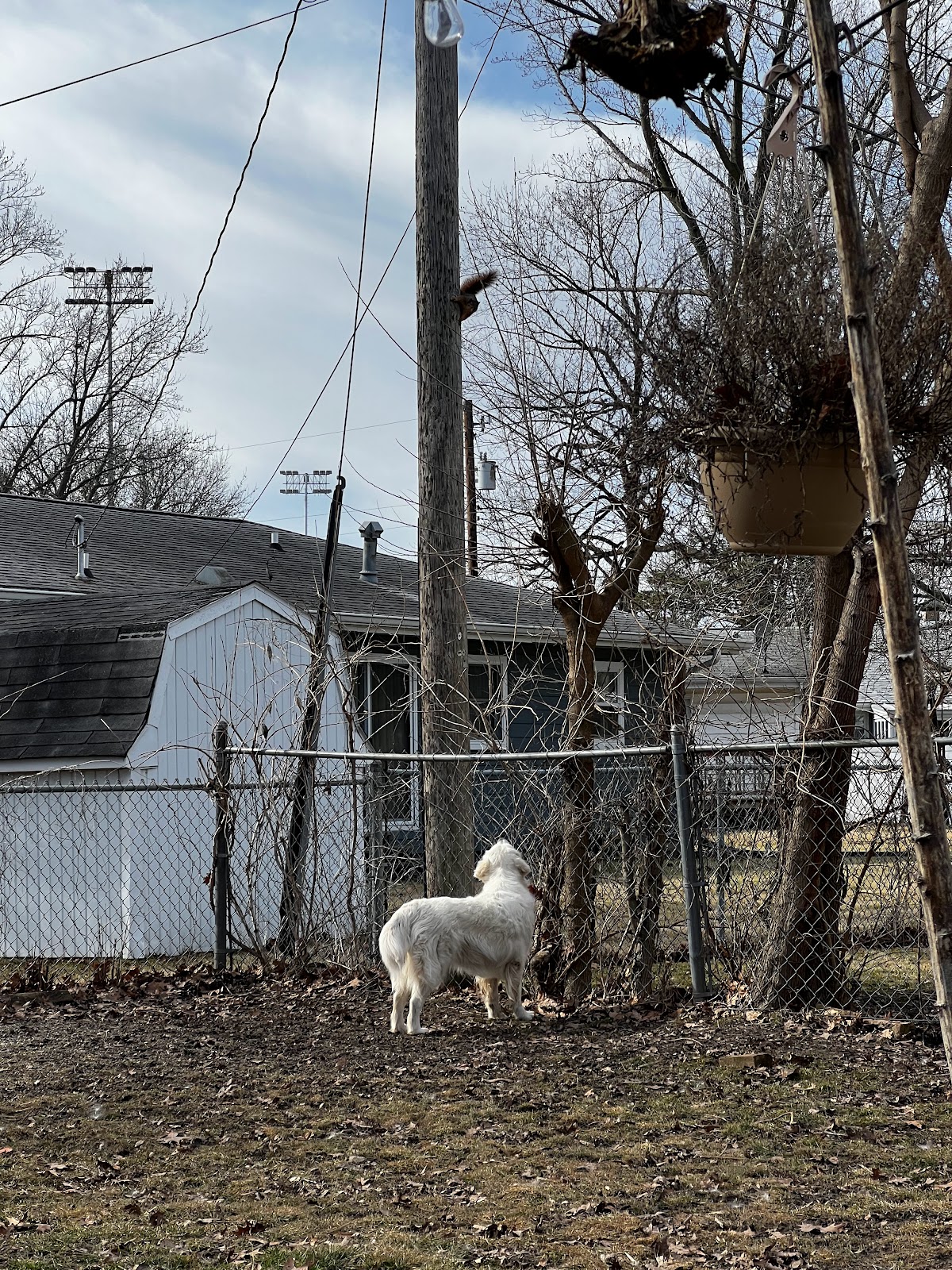
                 Sparrows, House Finches, Gold Finches, Grackles, Red-winged Blackbirds, and the occasional Starling have taken up residence. When it was 75 degrees yesterday, Robins stealthily tilted their heads, listening for their next meal beneath the Eairth. Today, with the wind howling and Winter reminding us that it isn’t Spring yet, chonky Squirrels suspiciously enter the yard, one eye fixed on the door looking for Tecumseh and Brigid, the other on the scattered birdseed on the ground. I love all these visitors!

                 In the wind, last year’s Sunflower stalks sway. Leaves rustle, occasionally rising and swirling, forming tiny tornadoes. My backyard probably annoys some. I didn’t rake all the leaves or turn over the garden. Yikes! I know! All the judgment. Instead, I wanted to leave the dead Plants and leaves for cover. Insects and other critters see our annoyances as places to dwell during those long Winter months. While my neighbors have, on multiple occasions, started up their small engines to rid their yards of Winter’s residue, I have not. I don’t mind the dead things in my yard. I love the process of becoming unfolding in my little patch of Eairth.

                 Our second week of Lent entry, written by Kelli Owens, gets to the heart of what this season asks us, “What is asking to die?” Dead Flowers and barren Trees are a noticeable reminder that there is a season for everything. The wind blows, and my windchimes sing, while the hanging Flower basket blows to and fro, a mere relic of what it once was last Summer. Things have died, but beneath and within, new life is happening. What is dead has released nutrients and is becoming life for other creatures. Returning. Reciprocity. Dare I say, Resurrection?

                 Across the way, a Maple Tree is budding. Beneath the leaves on the other side of my fence, something green emerges from the tans and grays. Death, yes, and life! Is this not Lent? We contemplate our mortality not as some spiritual masochism. “On the contrary, Lent is the one proof we have that the end of everything we face, all the struggles required of us, it is really meant to become new life in us.” (Joan Chittister)

                 I took a risk and opted not to ‘clean up my yard.’ Okay, that’s not a risk and is more dramatic than anything. But the dead Plants in my yard invite me to consider how I’m risking my life for the sake of Love. They ask me to consider what needs winnowing in my life so the fruits of the Spirit may emerge. Even in dying, a new thing is coming forth. It’s like what Paul says in Philippians 1, “For to me, living is Christ and dying is gain.” To resist dying leads to deeper suffering. The good news of our faith is that in dying and rising, what happens in the waters of our baptism, death is transformed!

                 My yard won’t win me any awards. No one will mistake me as a meticulous gardener. But it is a place for the wild things of Logan County—a place where death and life intersect and where Resurrection occurs. And, to me, that’s pretty wild.

The top left photo is of Brigid carrying a piece of a Sunflower root.
The second photo on the right is of a Tulip emerging through a pile of leaves.
The last photo centered below is of Tecumseh chatting with one of his many Squirrel friends.